Hawthorne Airport Public-Private Partnership Deal Signed in 2006 to Expand Airport, Prepare for Big Jets

From the Daily Breeze on 9/1/17

Hawthorne airport shuts down for remodel

In December 2006, the city worked out a public-private deal with real estate investors Wedgewood Properties, Kearny Real Estate Co. and Howard CDM to improve the property.

The companies are paying for new hangars and facility improvements, and will share profits from hangar rentals and other fees with the city.

The investment group funded a $1.2million refurbishment of the airport lobby and offices last year. They also brought in Million Air, a national company that provides airport and pilot services, to operate the airport’s restaurant, lobby, shuttle service to Los Angeles International Airport, airplane parking and fueling, and hangar maintenance, among other things.

They are also paying for dozens of new hangars in the next few years, said David Wehrly, vice president of Wedgewood Properties.
General Background on FAA and Airport Noise

UC Davis Aviation Noise Conference – March 2018

Aviation Laws Over the Years

Presenters:
Steve Alverson ES Associations
(Steve is also the FAA assigned consultant to assist the LAX Community Roundtable)
and Greg Maxwell, Casper

  • 1958 FAA Act – Congress recognized the public has a right to air transit – a right of national sovereignty.
  • 1968 Federal Aviation AC – noticed noise was a problem and decided to regulate noise with the highest standards of safety. Aimed at designing quieter aircraft.
  • 1969 FAA Promulgates CFAR Part 36 noise standards, set the maximum noise standards for new aircraft.
  • 1972 Noise Control Act – FAA could not certify an aircraft to fly if it didn’t meet noise standards. Stage 1-5 aircraft.
  • 1972 – ATA vs Crowdy – justify the ability to control noise is out of the hands of airports. Airports cannot charge fees based on noise and they cannot charge fees that are shifted to other community purposes. Funding must stay within the airport.
  • 1976 – FAAs Aviation Noise Abatement Policy – current noise policy. The draft policy in 2011 was never adopted or released.
  • 1979 ASNA Aviation Safety and Noise Abatement – Created the Part 150 Noise Reports, Noise Exposure Maps and Land Use Compatibility regulations (this is what Hawthorne Airport went through in 2012-2017).
  • 1988 – Stage 3 aircraft were mandatory
  • 1990 –  Airport Noise and Capacity Act – ANAC seminal point in airport noise, in exchange for phasing out the nosier stage 2 aircraft, the airports have to meet a higher standard for aircraft regulations.
    Airports with curfews and unusual noise control landing/takeoff procedures were grandfathered in as okay.

    14 CFR Part 161 – severely limits an airport proprietor’s ability to enact restrictions on aircraft operations. Encourage voluntary agreements to control aircraft noise. Any new noise control procedures or curfews the FAA must approve. They have only approved one over 30 years. The Part 161 process for airports is really difficult. Only 1 airport has tried and succeeded, most airports fail. LAX spent $10 million trying to get over ocean flights permanent and failed.

Other interesting aviation noise developments:

  • Newer aircraft are so aerodynamic they need lower altitude approaches (2.85-degrees) into the airport.
  • Today’s jets are the quietest ever
  • There is an impact of aircraft of noise on human health and on children
  • New trends include more community activism across the county, such as the Quiet Skies Coalitions
  • FAA acknowledges the 65 dnl “average” noise standard might not be appropriate for neighborhoods – 55 dnl?. New noise curves are expected from the FAA in June/July 2018.
  • CA law requires noise contours be supported by actual noise studies. Federal law allows noise models.
  • AEDT is the tool to be used for FAA reports and master plans. AEDT can also predict noise levels at sensitive locations: schools, hospitals and churches.
  • Air emissions can kill you – they do cause cancer and other bad things
  • FAA study – Airports that implement soundproofing programs are highly ranked by their neighbors, they get really good reviews from residents. Bc the resident can watch TV and talk on the phone and benefits from the soundproofing.
  • Airports file quarterly noise reports with the state to show how their noise contours are shrinking. >>Where is the State of CA noise reports filed?
  • Nighttime run-up and maintenance procedures are noise that can be regulated by local county health departments, noise ordinances and regulations. The FAA does not regulate on the ground noise, the County or local City does.
  • The FAA does not believe in Avigation Easements any more.
  • FAR Part 158 – Passenger Facility Charges – how airports collect soundproofing fees. Set at level of $1, 2 or 3. Airports may use PFC funds for noise mitigation with an FAA-approved FAR
  • It takes doubling of distance/altitude to achieve a 3db reduction in noise level.

Finally, What should residents do? Residents should become informed about aircraft noise impacts and act accordingly.

Experiences from Other Airports

Recommendations from Tahoe Truckee airport representatives suggestions for pilot, airplane and residential noise control:

  • Talk to Surf Air pilots they’re willing to work with local airports on flight paths for noise control and to benefit local residents
  • Have Hawthorne look into why their fly quietly guidelines are not loaded into the “ForeFlight” system which all pilots use.
  • Tahoe Truckee has two staff members dedicated to safety and noise: a Community Liaison Rep and Trainer for Pilots on fly quietly gudielines.
  • Also Hawthorne should contact Gretchen and Davey at San Carlos Airport to see how they worked out a deal with Surf Air pilots.

General Background on FAA Responsibilities from the FAA

Aviation Noise Abatement Policy

Federal Responsibilities

  • Regulation of noise at the source (engine noise emission standards)
  • Management of the air traffic control system consistent with the highest standards of safety
  • Financial and technical assistance to airport proprietors for noise reduction planning and abatement activities
  • In conjunction with the private sector conducts research into noise abatement technology
  • Introduced in 2016 is the FAA Community Involvement Manual (PDF). FAA Community Involved website.

Airport Proprietor Responsibilities

  • Primarily responsible for planning and implementing actions designed to reduce the effect of noise on the surrounding area
    • Selecting optimal site location
    • Improvements in airport design
    • Noise abatement ground procedures
    • Land acquisition

State and Local Government Responsibilities

  • Land use planning and development
  • Zoning to limit uses of land near airports to purposes compatible with airport operations
  • Housing regulation

Air Carriers Responsibilities

  • Retirement, replacement or retrofit of older aircraft that do not meet federal noise standards
  • Scheduling and flying aircraft to minimize the impact of noise on people
    • As a result of deregulation, FAA does not control airline schedules, the number of flights an airline operates, nor the type of equipment (aircraft) the airline operates.

The Airport Noise and Capacity Act (ANCA)

  • Establishes a process for airports to impose noise and access restrictions on the operation of Stage 2 and Stage 3 aircraft.
  • Applies to Stage 4 and 5 aircraft because they comply with Stage 3 standards
  • Applies to all public use airports
  • 14 C.F.R. part 161 contains the process for seeking a restriction
  • Two types of restrictions: Voluntary and Imposed
  • Voluntary Restrictions
    • Operator must notify air carriers providing service as well as potential new entrants at the airport
    • Operator must notify airport tenants, community groups, and federal, state and local agencies with land use control
    • Operators must agree to the proposed restriction
  • Imposed Restrictions
    • Requires FAA approval
    • Requires an analysis of the restriction that demonstrates by substantial evidence that the proposed restriction:
      • Is reasonable, non-arbitrary, and non-discriminatory
      • Does not create an undue burden on interstate commerce
      • Maintains safe and efficient use of the navigable airspace
      • Does not conflict with any federal statute or regulation
      • The applicant has provided adequate opportunity for public comment on the proposed restriction
      • Does not create an undue burden on the national aviation system.


Santa Monica Group Sends Pollution Warning Letter to Jet Company

More information about jet pollution and the impact on children from the Santa Monica Airport Future group (their letter is featured below)…

FPK is an environmental health advocacy group that has been studying the long term health impacts of aircraft operations, including operations at SMO. They are finding concrete evidence of toxins from the aircraft operations showing up in the air, the soil, and the bodies of people in the community. Testing has been done on hair, urine, DNA, soil, and air. The dangerous toxic metals and other substances are being found that have a unique “signature” traceable to the aircraft operations.  FPK reached out to Atlantic Aviation earlier this week to discuss this important issue negatively impacting the long term health and environment of the local community.


Jet Exhaust Found to be Dangerous, Particularly for Children

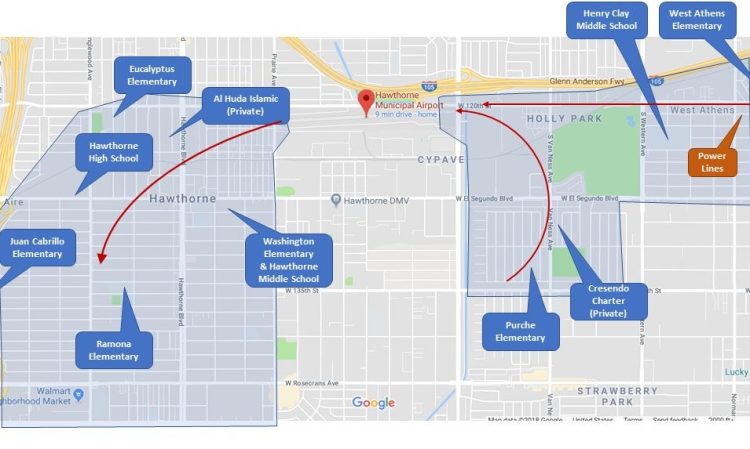
There are 10 elementary, middle and high schools in the Hawthorne Airport landing and takeoff zones that are being hit with ultrafine particulate pollution from jets,

An LA Times article from 2014 highlights a university research project into LAX pollution. The researchers found landings and takeoffs create ultrafine particulates that land on homes and school below the flight path.

As Hawthorne airport jet traffic expands neighborhoods, schools and children will be also be subject to more ultrafine particulate pollution. There are 10 schools in the landing and take off zones for Hawthorne Airport.

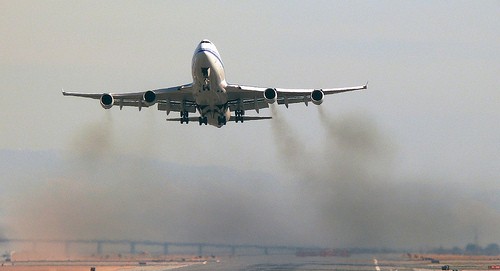
The findings raise health concerns, researchers say, because the minute particles, which result from the condensation of hot exhaust vapor from cars, diesel trucks and aircraft, have the potential to aggravate heart and lung conditions, including asthma and the development of blocked arteries.

Less than one-thousandth the width of a human hair, they can go deep in the lungs, make their way into the bloodstream and spread to the brain, heart and other critical organs. While emissions of slightly larger exhaust particles are regulated, ultrafines are not.

“This is a very novel and alarming set of results,” said Ralph Delfino, a professor of epidemiology at UC Irvine who studies the health effects of air pollution and reviewed the study. “It’s all very, very surprising.”

Continue reading the LA Times article

Surf Air Begins Helicopter Service from Orange County to Hawthorne Airport

Just what we didn’t need more helicopter noise on the way. According to the Robb Report…

Surf Air has made its service more appealing to residents of California’s Orange County. The all-you-can-fly membership airline recently added a helicopter shuttle between John Wayne Airport in Santa Ana and Hawthorne Airport near Los Angeles, where you can catch Surf Air flights to destinations throughout California.

The helicopter ride, provided by the aircraft charter service Blade, takes about 10 minutes, flying over the 35 miles of traffic on the 405. Passengers can arrive 15 minutes before the helicopter takes off. The price is $199 per person each way. The flights, which can carry six passengers, run Monday and Thursday mornings and evenings and Friday evenings.

Surf Air, which operates as many as 90 flights a day to a total of 11 California destinations and Las Vegas, was founded in 2013 and is headquartered in Santa Monica. Last year, it began operating in Europe, and it expanded into Texas by acquiring Rise, a similar all-you-can-fly membership airline.


Hawthorne Quiet Skies Coalition Hosts Successful Community Meeting – Feb 2018

Four neighborhood associations have joined together to work on Hawthorne Airport noise and safety issues. We held our first open community meeting in February 2018. Approximately 50 community members attended and shared their concerns.

Feb 2018 HHR Coalition Meeting agenda

Issues presented at the meeting included:

  • Current flight paths are a serious issue/pilots are not following fly quietly guidelines (pdf)
  • No one is willing to work with neighborhood associations on noise abatement. There is an endless circle of blame and excuses from government representatives: the FAA is responsible; the Pilots are responsible; the Airport is responsible; and so on endlessly.
  • Lots of community questions – no answers yet from the airport.

Continue reading “Hawthorne Quiet Skies Coalition Hosts Successful Community Meeting – Feb 2018”

Hawthorne Airport Fly Quietly Guidelines

Hawthorne Pilot Guide and Noise Abatement Procedures 2017 (pdf)

Source: City of Hawthorne

City staff has told us no one uses the guide, the only guidelines they follow is on departure they need to turn south away from LAX traffic.

One of the Chief Pilot’s said the guide is not used because it is unclear – pilots do not understand the street names that are referenced in the guidelines.

The FAA approved, City of Hawthorne Part 150 noise report promises this is the guide pilots will follow voluntarily.

Each of the our neighborhood coalition members report none of the planes follow the guidelines.

Wiseburn Watch Releases Petition Results – Jan 2018

We the people of Los Angeles County unincorporated community of Wiseburn CA 90250 want the Hawthorne Airport to end the practice of commercial and private aircraft flying over our city. This has increased dramatically the last year and a half. This is the area bordered by El Segundo Blvd to the North, Inglewood Ave to the East, Rosecrans Ave to the South and La Cienega Blvd to the west. There is a flight plan in place that diverts some takeoffs to turn south at Hawthorne Blvd and head south. This would be ideal to apply to all flights both VFR and IFR registered flights. We request that the FAA and the Hawthorne Airport select that departure policy as the standard. The increased noise and pollution are unhealthy. An example of this is the 6AM take off by jets. It’s not right to force disproportionate environmental impacts on our community to relieve another.
Again we request the flights over Wiseburn be redirected south paralleling Hawthorne Blvd to the south.

Sign the Wiseburn Airport Noise Petition Here >>

Continue reading “Wiseburn Watch Releases Petition Results – Jan 2018”

West Athens Community Letter to Congresswoman Waters

Here’s a letter the West Athens, Hollypark and Parkside Village communities sent to our representative Congresswoman Waters. She responded by participating in a community meeting in February 2018 and continues to help community members with airport issues.

Wednesday, November 29, 2017

Honorable Congresswoman Maxine Waters
US House of Representatives
2221 Rayburn House Office Building
Washington, DC 20515

Michael P. Huerta
FAA Administrator
800 Independence Avenue, SW
Washington, DC 20591

Via US Mail

Re: Hawthorne-West Athens Part 150 Participation

Dear Congresswoman Waters and Administrator Huerta,

We are located in the flight path of the Hawthorne airport. Our community is concerned about safety, noise and pollution issues caused by the increasing commercial air traffic into Hawthorne (HHR).

We have tried for over a year to engage with the airport; however, the airport says they are unable to schedule a meeting with our community at this time.  The airport is finishing their Part 150 noise study but never included the West Athens community as part of the process. Community members have sent Part 150 comment letters to the local FAA office which have gone unanswered.

Continue reading “West Athens Community Letter to Congresswoman Waters”