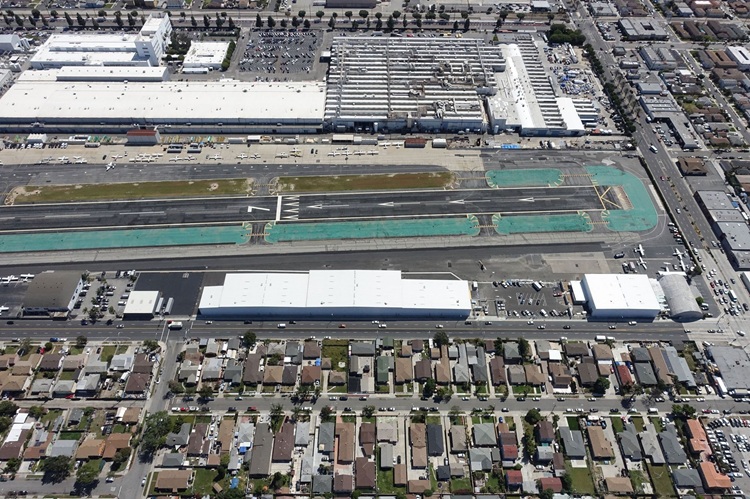
Featuring neighbors from Hawthorne, Gardena, West Athens, Redondo Beach and more discussing on-going noise and pollution from the Hawthorne Airport. Plus, we’ll suggest ways you can provide your input to the FAA.
“I feel like we’re living in a war zone, they come in so incessantly. Coming in, taking off, coming in, taking off. It’s out of control,” says Gutierrez-Hedges.
The school is beneath the flight path from Van Nuys Airport, one of the busiest general aviation airports in the country. …Since the pandemic, it’s gotten busier as more wealthy people pay to avoid the close quarters of commercial air travel.
But those extra fumes are descending upon the people who live nearby.
“Just this morning, as we’re walking outside to take my kids to school and getting in the car, I was like, ‘Cover your nose! Run to the car! Get in the car! Shut the door!’ I couldn’t breathe because of the jet fumes,” says Guitierrez-Hedges.”
“The old standard for tracking noise impacts was the Schultz Curve, developed 40 years ago, which tends to consider the irritations from airport noise rise slowly in a shallow curve. It predicted that at 50 DNL hardly anyone was bothered by noise, and by the time noise reached 70 DNL, only 40% of neighbors would be annoyed.”
NASA’s Advanced Air Mobility mission is developing design tools that manufacturers can use to reduce noise impacts. The Advanced Air Mobility (AAM) project and Revolutionary Vertical Lift Technology project work together to conduct testing with industry partners. The data NASA collects and analyzes from these tests with electric vertical take-off and landing aircraft (eVTOLs) will ensure that the agency’s aircraft design tools correctly predict noise levels for these types of vehicles. With tools that predict noise correctly, manufacturers can design vehicles for quiet operation in urban and rural areas.
The data will also help define and optimize AAM routes and low-noise flight paths for community needs and assist the Federal Aviation Administration (FAA) in creating policy. Lessons learned through these tests will inform the FAA’s ongoing work with operations and airspace integration.”
“Airport noise is a global issue, though the Netherlands may be a special case given that it’s one of the world’s most densely populated countries. Neighbors of Schiphol have recently found that their years of complaints finally paid off: the airport recently announced a series of measures that it hopes will lead to “quieter, cleaner and better aviation.”
The airport plans to ban private planes and cancel all night flights, moves that it estimates would reduce the number of residents experiencing severe sleep disturbance by 54%.”
While it may be obvious to the people it affects most, research now confirms that living next to an airport can seriously curtail how much sleep you get.
Researchers at the Boston University School of Public Health and Oregon State University published a study last month linking increased airplane noise with getting fewer than seven hours of sleep a night, the benchmark of a decent night’s rest for most adults. Shorter sleep duration or low-quality sleep over time can lead to a variety of health problems and affect your overall well-being. “
“Dispersing jet noise and particle emissions is an acknowledged antidote to concentration and is defined as “the process of introducing track variability by changing aircraft lateral position enough to spread out repetitive and intrusive noise events experienced by people living under highly concentrated flight paths” (UC Davis Aviation Noise and Emissions Symposium, February 2021).”
Noise and Advance Air Mobility Aircraft, Drones and Rotorcraft
Develop noise models for different types of Advanced Air Mobility vehicles: $315,000 to Massachusetts Institute of Technology.
Develop acoustic modeling for Urban Air Mobility vehicles with low noise operations: $280,000 to Pennsylvania State University.
Evaluate the noise exposure that could result from large numbers of commercial and private UAS vehicles: $300,000 to Georgia Institute of Technology.
Develop noise abatement procedures for helicopters in various phases of flight through computer modeling:
$170,000 to Pennsylvania State University. Noise and Communities
Assess and quantify if any correlation exists between aircraft noise, sleep, cardiovascular health and mental health: $1,999,608 to Boston University. Investigate the effects of aviation noise on sleep disturbance: $1,077,621 to University of Pennsylvania. Estimate if any housing value loss has occurred due to aircraft noise exposure: $300,000 to Massachusetts Institute of Technology.
“Lead was removed from gasoline decades ago. So why is aviation fuel still laced with the metal — a neurotoxin tied to developmental problems in children?
….
Today, toddlers in East San Jose have concentrations of lead in their blood on par with children tested at the height of the drinking water crisis in Flint, Mich., according to a recent study done in coordination with the California Department of Public Health. Meanwhile, aircraft in and out of the airport are flying on leaded gasoline three decades after the U.S. banned the fuel for cars.
Efforts since then to develop unleaded, or even less heavily leaded fuel for small airplanes, have been dependent on the approval of oil and aviation experts who meet through the nonprofit standards organization ASTM International.”